From Kolkata to the Cosmos: Science City’s Immersive Voyage to Mars
The occasion marked not merely the unveiling of a film but an invitation to reflect on humanity’s timeless fascination with the cosmos and its next great frontier.
In recent weeks, headlines have captured public imagination with the tantalizing phrase: “Dinosaur eggs found on Mars.” NASA’s Curiosity rover, tirelessly exploring the slopes of Mount Sharp in Gale Crater, recently imaged a set of rounded, clustered rock formations that immediately drew attention.




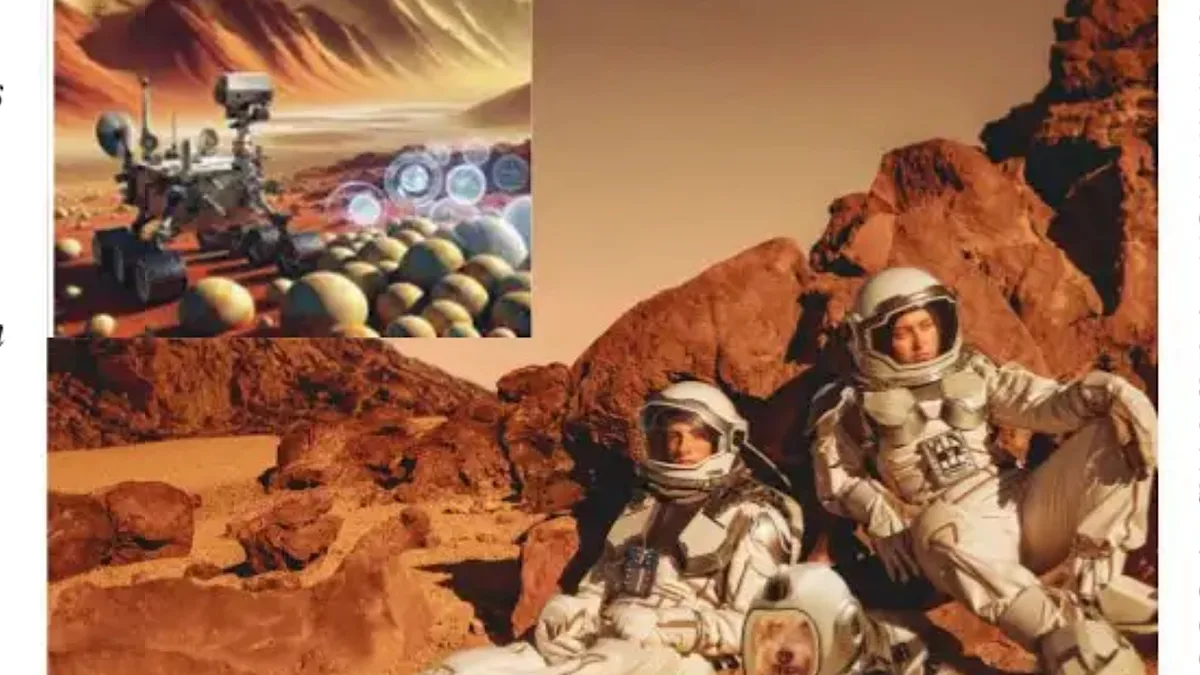
Photo:SNS
In recent weeks, headlines have captured public imagination with the tantalizing phrase: “Dinosaur eggs found on Mars.” NASA’s Curiosity rover, tirelessly exploring the slopes of Mount Sharp in Gale Crater, recently imaged a set of rounded, clustered rock formations that immediately drew attention. To the untrained eye, the resemblancance to a clutch of fossilized eggs is uncanny, leading many popular outlets to jump on the “dinosaur egg” metaphor. Yet planetary scientists are clear: these are not biological fossils, but rather natural geological features formed by mineral deposition and erosion in fractured rocks. Still, behind the hyperbole lies something truly significant.
These unusual formations ~ nicknamed “egg-like rocks” in the rover’s logs ~ are more than curiosities. They represent evidence of complex geological and hydrological activity in Mars’ past. In fact, they may record episodes when water, heat, and chemical interactions altered the crust, leaving behind structures that incidentally resemble the eggs of long-extinct reptiles. And it is this watery, active Mars of the past that fuels one of the most profound scientific questions of our time: did life ever evolve on Mars? To answer that, scientists turn back the Martian clock. About 4.1 to 3.7 billion years ago, during the Noachian epoch, Mars was very different from the cold desert we see today. Geological evidence shows extensive river valleys, deltas, and possible shallow seas. The planet’s atmosphere was thicker, temperatures could occasionally rise above freezing, and liquid water was stable on the surface.
Advertisement
If Earth’s microbial life emerged around the same time, could Mars have been home to microbes too? The idea is scientifically reasonable. For nearly 400 million years, Mars offered an environment where simple life could have taken root. But the planet was small, cooled quickly, and lost its magnetic field. Without protection, its atmosphere was steadily stripped by the solar wind. By the following Hesperian epoch (3.7–3.0 billion years ago), conditions worsened: water dried up, temperatures dropped, and habitability shrank to isolated underground niches. If life had started on Mars, it faced a grim future. Unlike Earth, which nurtured life continuously, Mars’ window of opportunity may have closed before evolution could move beyond the microbial stage.
Advertisement
The comparison with Earth is striking. On Earth, microbial life appeared about 3.8 billion years ago, yet complex multicellular life did not evolve until much later – roughly 600million years ago. That is nearly three billion years of microbial dominance. Mars simply did not enjoy such a long stable stretch. Its “biological clock” may have run out early. This explains why, even if Mars once hosted life, it likely never advanced beyond single-celled microbes. The discovery of “dinosaur egg-like rocks” reminds us of this sobering reality. The rounded formations are geological, not biological ~ but they hint at the presence of water and geochemical conditions that could once have supported life. They are geological echoes of Mars’ lost habitability.
The fascination with Mars is only part of a broader quest. Our Solar System itself presents multiple intriguing candidates for life. Jupiter’s moon Europa and Saturn’s moon Enceladus both hide subsurface oceans beneath icy crusts. Geysers venting from Enceladus have revealed water vapor, organics, and salts ~ ingredients for life. Titan, Saturn’s largest moon, has methane lakes and a thick atmosphere that may host exotic chemistry. Even Venus, once dismissed as utterly hostile, has re-entered the conversation after possible chemical signatures of phosphine were reported in its clouds, though that claim remains debated. The diversity of environments suggests that life, if it exists, may not always resemble Earth’s biology.
Microbial ecosystems could survive under ice, in hydrothermal vents, or even in exotic methane cycles. Mars remains compelling because it is nearby, ancient, and once Earth-like. But Europa and Enceladus may prove equally promising, protected from radiation and climate collapse by thick ice shields. Since the 1990s, astronomers have discovered thousands of exoplanets ~ planets orbiting stars beyond our Sun. Many orbit in the so-called habitable zone, where liquid water could exist. Particularly exciting are the Earth-sized worlds where several planets orbit within the right range for temperate conditions. Some exoplanets are “super-Earths,” larger and potentially more stable than our own planet. Others are ocean worlds with global seas.
The diversity of these discoveries forces us to broaden our imagination. If Mars could once have been habitable, how many exoplanets ~ more massive, more stable, orbiting longer-lived stars ~ might currently host thriving biospheres? Our telescopes are only beginning to probe their atmospheres, searching for bio-signatures such as oxygen, methane, or combinations of gases that indicate life’s metabolic activity. The “dinosaur egg” rocks on Mars are not fossils, but they do what good science often does: spark questions that reach far beyond their immediate context. They remind us that planets are dynamic, that habitability is fragile, and that the story of life is entwined with planetary history. Earth is not unique in having had habitable conditions ~ but it may be unique in sustaining them for billions of years.
If life ever existed on Mars, it may have been extinguished or forced underground, never reaching higher complexity. If life thrives today in the hidden oceans of Europa or Enceladus, it may teach us that biology is more resilient than we imagine. And if we find life on exoplanets, the discovery would reshape humanity’s place in the cosmos. In conclusion, Curiosity did not find dinosaur eggs on Mars. What it found is perhaps more important: geological evidence of water-altered processes that point back to a time when Mars could have been alive. The rocks are not fossils, but they are storytellers, whispering of an ancient planet that once had rivers, lakes, and maybe even microbes. As we extend our search across the Solar System and to distant stars, one truth becomes clear: the universe is rich with possibilities, and Mars’ “eggs” are only one reminder that the question of life beyond Earth is not fanciful, but a scientific frontier waiting to be crossed.
(The writer is ex-ISRO Brahma Prakash Professor)
Advertisement